Thursday, March 07, 2013

#539 Size Matters

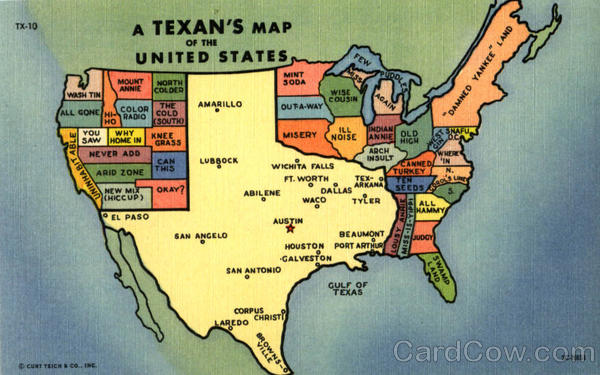
In geography, size matters.  On maps, large always wins over small.  We're human.  We're wired to quickly spot patterns and make visual comparisons.  See Tufte, Edward.

Picture a map of your own state.  How does it compare in size to the states next door, the largest states, the smallest, or Texas?

I recently joined with map-minded folks to build GeoTron 5000 to put the power of comparative geography and spatial literacy in hand.  Choose two places and the GeoTron 5000 robot spins up two maps to show exactly how those places compare.
Texas vs. Alaska

So what's going on behind the scenes in GeoTron 5000 to enable these mappy comparisons?
Natural Earth & Quantum GIS

GeoTron 5000 houses an international map library based primarily on Natural Earth, a fantastic public domain vector dataset.  The Natural Earth maps were pre-processed using Quantum GIS geographic information systems software to present consistent comparisons of land area from California to Kyrgyzstan.  International country lists and official land areas were harvested from the United Nations Statistics Division via their World Statistics Pocketbook and Demographic Yearbook.  Domestic datasets are from the US Census.

GeoTron 5000 is free at the Apple App Store and includes all 50 US States and the District of Columbia.  Additional geographies outside the USA are available for comparison via in-app purchase.  The app requires no cell service, no internet connection, and no international data plan when traveling.

Travel is one of the best tests of our spatial literacy.  When away from familiar territory we can use the size of places we know well to better understand places we've never visited.  Travel guide books assume a high degree of spatial literacy when offering comparisons like "Germany is about half the size of Texas".  But spatial thinking is best served when we choose familiar frames of reference.  For example, to understand the relative size of China's Great Wall, HowBigReally.com displays the massive wall scaled and centered over any location, here Charlottesville, Virginia:
SizeMattersHowBigReally

Visualizing comparative size and shape requires skill in spatial thinking. Packing a suitcase, parking a car, finding a restaurant, finding your car when leaving the restaurant...all involve visualizing spatial relationships based on size, distance, shape, and changing points of reference.  Artsy infographics overlay the world on Africa and popular television explores Mercator's map distortions.  We're all thinking spatially every day.
"Spatial literacy is the competent and confident use of maps, mapping, and spatial thinking to address ideas, situations, and problems within daily life, society, and the world around us." - Diana Stuart Sinton, Geographer and Spatial Thinker
Universities host spatial studies centers, organize spatial studies conferences, and offer graduate level training in spatial literacy.  And spatial literacy is a topic of growing academic focus beyond the higher ed classroom. Kids love maps.  Using maps to illustrate comparative size promotes spatial thinking at an early age.
"Spatial thinking can be learned, and it can and should be taught at all levels in the education system." - National Research Council
Much of Edward Tufte's brilliant work on visual literacy is centered around maps.  In Envisioning Information he writes of maps:

"No other method for the display of statistical information is so powerful."

Scaled maps for geographic comparison using How Big Really or GeoTron 5000 inform spatial reasoning by answering the key question: compared to what?

Size matters.

[Cross-posted with scholarslab.org]

Sunday, January 20, 2013

#538 Nautical Reading

When I’m not sailing on the MV Explorer, I like to read nautical fiction - novels and mysteries set on board ocean liners.  And if a shipboard library is part of the story, so much the better.

To be sure, there are plenty of fun, non-fiction books set on ocean liners.  A couple of my favorites are Innocents Abroad Too: Journeys Around the World on Semester at Sea (2008) by Michael Pearson and The Only Way to Cross (1978) by John Maxtone-Graham.

But today's post is all about the fiction.

The Luck of the Bodkins (1935) by P G Wodehouse.  I’m a loyal Wodehouse fan and this is one of my favorites.  “This is Wodehouse afloat – a voyage of pure delight.”  Set on the S. S. Atlantic as it crosses from Southampton to New York, a movie mogul, a ladies hockey team, 2 Tennyson brothers (but neither the right Tennyson), an actress traveling with an alligator, and a sassy steward make for an engaging plot. 

Santa Cruise: A Holiday Mystery at Sea (2006) by Mary Higgins Clark.  A mystery set on a cruise ship at Christmas?  Of course, I read it.  A collection of charity donors are honored with a Santa Cruise in the Caribbean, not knowing two criminals were smuggled on board in Miami in order to escape the US.   Plenty of nautical language like cabin, deck, captain, medical clinic on lower deck, bow, stern remind me of the MV Explorer.

Set Sail for Murder (2007) by Carolyn Hart.  The cruise up the Baltic to Saint Petersburg, Copenhagen, and Tallinn, is the setting for this cozy mystery. Jimmy Lennox is worried that one of his wife’s stepchildren is trying to murder her, so he calls up his old friend Henrie O to help protect her.  We read about ship life and port highlights, but, alas, there's no mention of a shipboard library.


But the best is yet to come.  I discovered the eight shipboard mysteries by Conrad Allen packed with political history, shipboard life, class distinctions, clothing descriptions, historical events, and best of all, real ships.  For me, this author is the captain of shipboard mysteries. 

Murder on the Lusitania (1999). Set in August 1907 on the first sailing of the RMS Lusitania from Liverpool to New York City, George Dillman is a yacht-builder-turned-Pinkerton-detective hired by Cunard to protect the passengers on this inaugural crossing.   Passengers are speculating about the possibility of taking the Blue Riband speed record back from the Germans for the fastest transatlantic crossing.  George blends in with the first-class passengers and gets to know them before one of the journalists is found murdered. 

Murder on the Mauretania (2000). "The Mauretania has 25 boilers, 192 furnaces, and a storage capacity for 6000 tons of coal.  That may sound like a lot, but then we use up 1000 tons of coal a day.”  Set in November 1907 on the first sailing of the Mauretania from Liverpool to New York City, George Dillman is back as the ship’s detective and this time he is joined by his girlfriend and co-detective Genevieve Masefield.  Genevieve had helped solve a mystery on the Lusitania in August.  This time, the ship is carrying millions of dollars in gold bars.  Max Hirsch is a silver thief who is sweeping through the 2nd-class cabins and then goes missing during a violent storm.

Murder on the Minnesota (2002).  Set in November 1908, George and Genevieve take a leave from their Cunard detective jobs to sail on the SS Minnesota of James Hill’s Great Northern Steamship Company.  The purser is a friend of George and asks him to help solve a smuggling mystery during a crossing of the Pacific to China.  When the obnoxious missionary Father Slattery is murdered in his cabin, they have even more work to do.  The ship is described in detail – 37 electric winches!  And the ship has a library with a copy of Grove’s dictionary of music in its collection but no Shanghai business directory.

Murder on the Caronia (2003). The RMS Caronia was a British ocean liner that first sailed in 1905, served as an armed merchant cruiser during WWI, and was scrapped in 1933.  The novel takes place in 1908, early in her career.   George and Genevieve are serving as detectives for Cunard and are asked to solve 2 murders – one on the ship during their voyage and one on land prior to the voyage.

Murder on the Marmora (2004).  The Marmora was a Peninsular and Oriental (P and O) vessel built in 1903 and became an auxiliary cruiser during WWI.  The novel takes place in December 1908 on a voyage over Christmas from Tilbury, England to Port Said, Egypt.  George and Genevieve are serving as detectives, but this time for P and O, not Cunard.  The Duke and Duchess of Fife (Princess Louise) and their children are on board and everyone wants to see them, take a photo of them, cook for them.  The purser is not as helpful as usual, but in the end George and Genevieve recover the stolen property, uncover the murderer, and are married by the captain.

Murder on the Salsette (2005).  The SS Salsette was torpedoed during WWI in July 1917.  The novel takes place in May 1909 on a voyage crossing the Arabian Sea from Bombay (Mumbai), India to Aden, Yemen.  George and Genevieve are serving as detectives for P and O when an ugly murder takes place during a time when England holds colonial rule over India.

Murder on the Oceanic (2006). The RMS Oceanic was built in 1899 as a transatlantic ocean liner for the White Star Line and was the largest in the world for two years.   At the outbreak of WWI, she was commissioned into the service of the Royal Navy and ran aground while patrolling the Shetlands.  We learn that White Star Line has moved from Liverpool to Southampton because it is deeper, has double high tides, and is closer to London and France.  The novel takes place in March 1910 on a voyage crossing from Southampton to Cherbourg to Queenstown to NYC.  J. P. Morgan, American banker and owner of White Star Line, boards in Cherbourg carrying treasures he purchased in France.  George and Genevieve are  serving as detectives when Morgan’s bodyguard is murdered and the art is stolen.   I especially like the library description:  “It was a well-stocked room of medium size with leather sofas and matching armchairs.  At one end was a long table with a number of chairs around it.  Hundreds of books lined the walls.”

Murder on the Celtic (2007).  The RMS Celtic was built in 1901 as a transatlantic ocean liner for the White Star Line.  She was commissioned into military service at the outbreak of WWI.  The novel takes place in 1910 crossing east from NYC with the famous Brit Sir Arthur Conan Doyle on board.   George and Genevieve help to return the stolen book to Sir Arthur and solve a murder.  The library is mentioned 5 times but there is no description.

Most of the Conrad Allen titles are available at our local public library, but I purchased used copies and donated them to - where else? - the MV Explorer browsing library on Christmas Day!

Be sure to tell me if you discover some nautical fiction!

Yours in armchair sailing,
Mary
Friday, January 11, 2013

#537 Christmas at Sea - Top Ten

Christmas at Sea.  What a fabulous idea!  

The sea was calling so we sailed 8500 miles around Central and South America on our favorite ship, the MV Explorer, with 8 bold friends while making tons of new friends, docking in 10 foreign countries, and creating a boatload of great memories.

The photos are many (the brave can click "See all our photos") and the highlights greatly outnumber the photos.  So let's count down ten highlights for a glimpse of our holiday at sea: 

Highlight #10 - shortening our winter by traveling to 10 foreign countries all in tropical climes.

Highlight #9 - enjoying the 9 celebrity spottings each day in the shipboard library.

Highlight #8 - convincing these 8 dear friends that spending a Christmas at sea was the perfect plan.


Highlight #7 - celebrating Kelly's birthday dinner under the stars on deck 7 with presents creatively wrapped with toilet paper and seasickness bags, drinks from the pool bar, and fun stories of how everyone met.
 
Highlight #6 - arising at 6 AM to enter the Gatun Locks of the Panama Canal.

Highlight #5 -  keeping the average length of the computer support waiting line down to 5.

Highlight #4 - meeting in person that 4-legged animal so vital to the Incan civilization - the llama.

Highlight #3 - delivering gifts at 3 AM on Christmas morning so Santa could avoid the watchful eyes of our late-night friends and our early-morning friends.

Highlight #2 - visiting 2 public libraries: one in Montego Bay and this one in Cartagena.

Highlight #1 - spending the 1 day before the predicted end of the world at the 1 place we wanted to be.

Yours in appreciating Santa, the Mayan calculation error, the Incan ingenuity, and our intrepid friends,
Mary

Sunday, November 04, 2012

#536 Christmas at Sea

Season's Greetings!

Kelly and I have celebrated most of the significant holidays at sea - Super Bowl Sunday, Valentine's Day, Saint Patrick's Day, Independence Day, Halloween, Thanksgiving, my birthday month.  

But never have we celebrated a Christmas at sea - until now.  This December, we will be sailing on the MV Explorer with an enrichment voyage to Central and South America

Our itinerary includes the Bahamas, Jamaica, Colombia, Panama and its canal, Ecuador, Peru, Costa Rica,  Nicaragua, Guatemala, and Mexico.


We'll be in Costa Rica on December 25 where the high temperature for Christmas Day averages 87 degrees.  So that severely limits our chances of a 2012 white Christmas.  And although the cabins on the MV Explorer are quite nice, there's no chimney for Santa's big entrance.  Christmas 2012 will be different.

Want to find out whether Santa can find us in Costa Rica?  Want to experience a snow-free Christmas season at sea?  Then come join us!  Let me know by November 15 for the inside scoop!

Yours in Ho-Ho-Ho-ing at sea,
Mary
 

Sunday, September 16, 2012

#535 Silent film extravaganza


Inspired by our recent viewing of the Oscar-winning silent film The Artist, we have now traveled further down the silent film wormhole...

The Artist (2012) was set in 1927 at the time Paramount Pictures released Wings and The Wedding March.

Wings (1927) is a silent film about WWI fighter pilots with spectacular dogfights, the introduction of Gary Cooper, and an all-organ score. It was the only silent movie to win the Best Picture Oscar until 2012's The Artist.

The Wedding March (1928) is a silent film set in Vienna about a a roguish Viennese prince who agrees to marry for money and then falls in love with an inn-keeper's daughter (Fay Wray).

So, of course, when the Packard Campus for Audio-Video Conservation in Culpeper, Virginia (about an hour from Charlottesville), announced a showing of The Wedding March, we were there. The bucolic setting with panoramic Blue Ridge Mountain views, modern architecture, green roofs, and endless plantings make the place seem more like a botanic garden than the cold-war currency bunker from which it sprang.

Library of Congress Packard Campus for Audio-Video Conservation
Just off the soaring lobby, the elegant theater seats over 200 people and screens films year round free of charge to the public.  In the same building with one of the world's largest film collections (over 80% of American movies made between 1893 and 1930 have been lost, according to the Library of Congress) this is a theater with extra special features like an organ rising from below the stage for silent film showings. In the silent film era, every showing included a live sound track. 
Packard Campus Theater
In this unique setting, we crossed paths with a premier silent film accompanist, Ben Model who turned his passion for film and music into a unique career that puts him in high demand.  He's already performed over 150 times in 2012 including a gig earlier this day at the National Gallery of Art in DC. 
Ben Model - silent film accompanist
The house lights dropped, the organmeister and instrument slowly descended from their pre-show perch to a performance position at stage height, and The Wedding March appeared before us.

Yours in enjoying some silent film history via the Library of Congress,
Kelly

Saturday, July 21, 2012

#534 George Washington Defaced It, Thomas Jefferson Bought It, We Visited It


  • George Washington defaced it (some say) by carving "GW" into the rock during his 1750 surveying visit.  
  • Thomas Jefferson bought it from the King of England for a few dollars, built a private home there, and tagged it "the most sublime of nature's works".  
  • The National Register of Historic Places listed it as a National Historic Landmark.
  • Herman Melville used it to as a literary device to describe Moby Dick
It's Virginia's Natural Bridge.  So we stopped by to see what all this fuss is about.

Virginia's natural beauty, lush and green, engulfs the place.  But the incredible coming together of nature's forces to create this oddment is the real story.  Tectonic plates, continental collisions, limestone's incremental yielding to the unstoppable forces of water, and poof, a natural miracle happened before we were watching.

Seated on benches facing the bridge, we heard a well-delivered scholarly description of the natural and human history of this dramatic place.  Later we engaged costumed interpreters at the Monocan village in the bridge's shadow and got a sense of the depth of their knowledge of Native American life.  These educational interludes (our highlights) were pleasant surprises given the for-profit nature of this place.

Yes, there's a gift shop. Virginia's Natural bridge - "it's easy to get to and hard to forget".

Yours in admiring Mr. Jefferson's real estate acumen,
Kelly

Sunday, July 01, 2012

#533 Virginia is for Reading


Geography matters in my reading choices.   

Since moving to Charlottesville five years ago, books such as these written by or about Virginians often get to the top of my fun reading list.   

The Art of Fielding (2011) by Chad Harbach, a UVA graduate.    

Audrey (1902) by Mary Johnston, a women's rights activist from Buchanan, VA.

Big Stone Gap (2000), Big Cherry Holler (2001), Milk Glass Moon (2002), and Home to Big Stone Gap (2007) by Adriana Trigiani.
"We got a revival down in the Frog Level." 
"Don't lose it.  UVA'll have my hide."
"You make it sound like a mail-correspondence college.  It's the state university of Virginia, founded by Thomas Jefferson.  It's not some dump."
Bossypants (2011) by Tina Fey, a UVA graduate.  
"Let me start off by saying that at the University of Virginia in 1990, I was Mexican."
"This worked out perfectly for me in college, because what nineteen-year-old Virginia boy doesn't want a wide-hipped, sarcastic Greek girl with short hair that's permed on top?"

Christmas at Monticello with Thomas Jefferson (1959) by Helen Topping Miller.   

The Disagreement (2008) by Nick Taylor, a UVA graduate.
Historical fiction set during the Civil War at the University of Virginia.  "My sense of the University's plan was not yet firm, but from my father's engraving, I knew that the buildings were arranged in two horseshoes, one inside the other.  Service buildings such as Hotel A sat on the outer row.  The grand Rotunda, which served as the library, fit like the keystone in the top of both rows."
Innocents Abroad Too: Journeys Around the World on Semester at Sea (2008) by Michael Pearson, a Fall 2006 SAS alum.   


"Moreover, folded into its pages were informational materials from institutions such as the University of Virginia's Alderman Library, a disturbing clue that other thefts may have already taken place." 
"Officials at the Alderman Library reported that at least seven rare maps were missing, including eighteenth-century works by the cartographers Herman Moll and Andrew Ellicott."

London is the Best City in America (2007) and The First Husband (2011) by Laura Dave, a UVA graduate. 

The Right Attitude to Rain (2006), The Careful Use of Compliments (2007), and The Comforts of a Muddy Saturday (2008) by Alexander McCall Smith.   
Though the Isabel Dalhousie series is set in Edinburgh, the author mentions Charlottesville in each of these books. In The Right Attitude to Rain, Isabel is asked if she enjoys living in Edinburgh and responds "I do like it.  But I'd be happy living in other places, I suspect.  New York.  Charlottesville, Virginia.  To name just two.  I'm sure I'd be happy there."

The Scrapbook of Frankie Pratt: a novel in pictures (2011) by Caroline Preston, a Charlottesvillian.

Something Borrowed (2004) and Something Blue (2005) by Emily Giffin, a UVA law graduate.  

The Trail of the Lonesome Pine (1908) by John Fox Jr, who lived in Big Stone Gap, VA.

When the Whistle Blows (2009) by Fran Cannon Slayton, a UVA graduate.

Next up: A Girl of Virginia (1902) by Lucy Meacham Thruston.

Yours in appreciating the long and growing literary tradition of Virginia,
Mary